Someone somewhere once said: "age is no excuse for weakness."
I believe that is true.
As millions of Baby Boomers and beyond enter their golden years, they hope to be active, and stay healthy and injury-free. However, the greatest challenge in doing so for many has been and will be a sedentary lifestyle.
Many older adults have the perception that they cannot exercise for fear of injury, when just the opposite is true. A body will respond to proper training regardless of age. Unfortunately, many older adults fail to realize that someone who does not exercise is potentially more prone to injury and poor health.
WHAT HAPPENS AS WE GET OLDER?
Balance, agility, proprioception, and kinesthetic awareness all start to diminish as we age or become sedentary. We use vision, the vestibular system and the complex of nerve endings in our muscles, joints and tendons to keep ourselves upright. As we get older or become sedentary, these sensory systems operate less effectively.
Additionally, the muscular system starts to weaken from the core to extremities as we get older. Our core (consisting of the abdominal wall, back, and pelvic musculature) becomes weak with progressive weakening of the hip and shoulder stabilizers. Loss of flexibility also impairs our ability to move properly and hold good postural alignment. As a result, many older adults experience orthopedic injuries such as hip and shoulder fractures from falls due to loss of balance, and to overuse-repetitive stress injuries.
Our skills for focus and memory retention also diminish as we age. Osteopenia and osteoporosis can complicate exercise programs, limiting some forms of training. Arthritic and degenerative changes, high blood pressure, pelvic floor dysfunction, and many others can be added to the list.
Many therapists are turning to Pilates as a method of rehabilitation and training for older adults experiencing these aging-related challenges.
WHY PILATES?
Pilates is effective because it is an extremely flexible rehabilitation system. Exercises can be modified based on each client's needs to best facilitate a positive movement experience. The exercises can be assistive in nature or, as a client gets stronger, modifications can be made to make the exercises more challenging. The training is low impact and weight bearing, and positional restrictions can be accommodated.
Pilates starts with nine principles of training that make it a perfect therapeutic remedy for this population:
- Breathing—the essential link between the mind and body, relaxes, improves focus.
- Concentration—paying attention to movement quality.
- Control—optimizing form and technique.
- Centering—moving from a stable, balanced and flexible core.
- Precision—greater efficiency in movement patterns.
- Balanced muscle development—postural and muscular symmetry.
- Rhythm and Flow—smooth flowing movement.
- Whole Body Movement—integrating movement through the mind, body and spirit.
- Relaxation—using just the effort needed to accomplish a task, and releasing tension.
Through Pilates an older adult can achieve a strong core, integrating stabilizing muscles, and creating a strong, balanced foundation from which to move. Pilates enables them to better react to their environments.
CONDITIONS TO CONSIDER
As is the case when working with any specialized population, you will need to be aware of certain cautions when using Pilates with older adults. For example:
- Osteoporosis—Many Pilates exercises incorporate flexion-oriented movement. For osteoporosis sufferers, flexion is contraindicated. We recommend clients at risk of osteoporosis get a bone density scan to find out their T-score. A T-score of -1 to -2.5 indicates osteopenia, or 10-25% below normal bone density. Caution is required when moving into flexed postures. A T-score of >2.5 indicates osteoporosis and all flexion of the spine is contraindicated. The beauty of Pilates is that modifications can be made to meet the needs of people afflicted with osteoporosis. (See case study)
- Arthritis and Degenerative Conditions—By the time we reach middle age and above, most of us have some level of arthritic or degenerative changes in the joints of our extremities and spine. As with any form of exercise, appropriate precautions need to be observed. The low impact, controlled environment of Pilates training is ideal for managing and improving mobility and strength.
- High Blood Pressure—One of the principles of Pilates is breath work. Breathing can reduce anxiety, focus attention and lower blood pressure during exercise. For people with high blood pressure or an ailment like glaucoma, breath work incorporated into Pilates is very important to make sure they are not spiking their blood pressure.
THE RIGHT EQUIPMENT
 |
| Exercise balls and foam rollers can be incorporated into a modified, at-home Pilates regimen. |
Pilates equipment includes: the reformer, trapeze table, chair, barrels and small apparatus, such as circles and the Pilates mini-balls.
For an older client population, the trapeze table and clinical reformer are ideal due to the ease of getting on/off the equipment, and to the variety of exercises one can perform on each piece. This versatility is a key benefit; you can make more efficient use of your time instead of having to move older clients from one piece of equipment to another.
Mat Pilates is a great form of exercise for home programs. You can incorporate the principles of Pilates and modify the exercises using foam rollers and exercise balls for home programs.
CASE STUDY: TREATING OSTEOPOROSIS
Client "A" is a 5 foot, 7 inch, 120-pound, 67-year-old female. She was diagnosed with "established" osteoporosis 3 years ago with a T-score of -2.2 of the lumbar spine and -3.2 at the femoral neck. She initially had a single leg standing balance of <>
She started Pilates training three times per week and began using the medication recommended by her physician. After 1 year, her T-scores were -1.3 at the lumbar spine and -2.4 at the femoral neck. In addition, her diagnosis has changed from osteoporosis to osteopenia. Her balance has improved to allow single leg standing >90-seconds while doing standing Pilates exercises including single heel raises. The fracture risk for the client has gone from high to moderate, and her fall risk from high to low.
Rob Kopitzke, PT, MPI, USACC, NMR, is the president of Body Concepts Inc, a Pilates-based physical therapy clinic in El Dorado Hills, Calif. Kopitzke has extensive training in biomechanics of the foot and lower extremities. Two long-term manual therapy courses on the spine and a variety of other orthopedic-sports medicine courses round out his physical therapy training.
Types of Pilates Equipment Found in Therapeutic Clinics
THE REFORMER
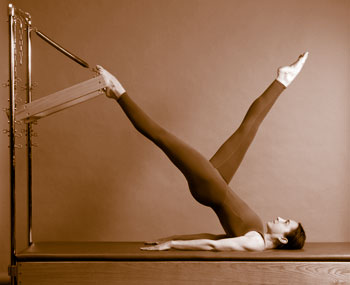
The Reformer is the most well-known piece of Pilates equipment, providing an effective, low impact resistance-based workout that is friendly to the joints. It consists of a gliding carriage inside a wooden or metal frame connected to a system of springs, pulleys and ropes. Users sit, kneel, stand, or lie on the carriage and push and pull the footbar and the ropes. Resistance is provided by the attached springs. Reformer exercises target every part of the body.
TRAPEZE TABLE (OR, THE CADILLAC)
The Cadillac is a raised horizontal table-top surrounded by a four-poster frame, on which various bars, straps, springs and levers are fixed. A tremendous variety of exercises can be performed on the Cadillac—from gentle spring-assisted sit-ups to advanced acrobatics while hanging from the upper bars. Resistance is provided behind, in front, and above at a variety of different angles.
THE REFORMER/TRAPEZE COMBINATION
This piece of equipment combines the Reformer and the Trapeze Table. The Reformer is hidden underneath two, removable tabletop mats, and greatly increases the amount of exercises that can be done. Another variation—the Reformer/Trapeze combination resembles a standard Reformer, with a half wall of Cadillac features on one end.
FITNESS CHAIRS
Pilates fitness chairs activate the legs, buttocks, shoulder girdle, arms and core, as well as heightens neuromuscular coordination. Pilates fitness chairs (or combo chairs) resemble a stool with single or split steps at the bottom. Handles, chair backs, rotational discs, and other accessories can be added for increased variety.
Although many exercises are performed sitting on the chair and pressing down on the steps or pedals, many more can be performed lying on the floor, standing up, or lunging forward.
MAGIC CIRCLES
This is a circular ring made of sprung steel or flexible plastic, with contoured handles. Circles are available in a range of resistance tensions (from band level 2 to 4) and diameters (12 inches to 14 inches) to meet the needs of different body sizes and ability levels. They can be used standing, sitting or lying down on your front, back or side. Magic circles are a simple way to add resistance training to mat exercises.
THE LADDER BARREL
This consists of ladder-like rungs and a rounded barrel-like surface on which a multitude of stretching, strengthening and flexibility exercises can be performed. The barrel is separated from the ladder by a sliding base that can adjust to accommodate different torso sizes and leg lengths in a range of Pilates exercises.


 With school out and your young kids at home, they've got a lot of extra time on their hands. The mere mention of fitness and taking them away from the TV or their favorite video games can often evoke reactions usually reserved for doing chores, getting haircuts, or visiting the dentist.